Nanoscale Secondary Ion Mass Spectrometry Lab
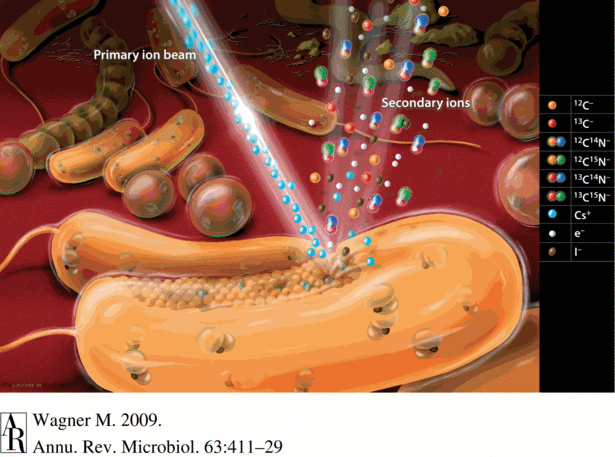
Analytical nanometer-scale secondary ion mass spectrometry (NanoSIMS)
imaging is perfectly suited to measure and visualize the distribution of
virtually any elements and their stable isotopes in samples of various origin
(from biology to cosmochemistry to material science). The CAMECA NanoSIMS 50L,
available since 2010 at the Large-Instrument Facility for Environmental
and Isotope Mass Spectrometry, offers a spatial resolution for elemental/isotope
mapping down to 35 nm and allows highly sensitive analyses at the
sub-cellular level.
Services we provide
Beyond performing measurements, our facility offers extensive support to all
users with respect to study design, sample preparation and pre-characterization,
data evaluation and data interpretation, which are key steps in an efficient
NanoSIMS analysis.
Applications for NanoSIMS projects
within biology, chemistry, medicine, materials science and earth sciences.
You can learn more about our
cost model here
.
Key research fields
In microbial ecology we combine NanoSIMS with stable isotope probing
(e.g. 2H/1H, 13C/12C,
15N/14N), high-throughput elemental analysis -
isotope ratio mass spectrometry (EA-IRMS), Raman micro-spectroscopy
and single-cell identification techniques such as fluorescence in situ
hybridization (FISH) for obtaining information about the phylogenetic identity
and functional role of microorganisms in their environment.
In collaboration with colleagues from the Department of Inorganic Chemistry,
NanoSIMS has been exploited for studying the sub-cellular distribution of
isotopically-labeled metal-based anticancer drugs within cultured malignant
cells and murine tissues. Combining NanoSIMS with fluorescence microscopy,
LA-ICP-MS, and TEM has proven successful.